
Post-Pandemic Earth System Dynamics
When COVID-19 brought the world to a halt in early 2020, something remarkable happened: skies cleared, emissions dropped, and for a brief interval the planet appeared to breathe again. Air pollution levels fell by as much as 30% in some cities. Wildlife reclaimed urban spaces. Global carbon emissions declined by roughly 5.5% in 2020; the largest annual drop on record.
But as months turned to years, that progress proved fleeting. By 2024, global CO₂ emissions had hit a record high of 37.4 billion tons, not merely rebounding to pre-pandemic levels but surpassing them. Atmospheric CO₂ concentrations reached 422.5 ppm in 2024, around 50% higher than pre-industrial levels. Economic recovery efforts prioritised growth over green goals, and the window for limiting warming to 1.5°C (34.7°F) continues to narrow.
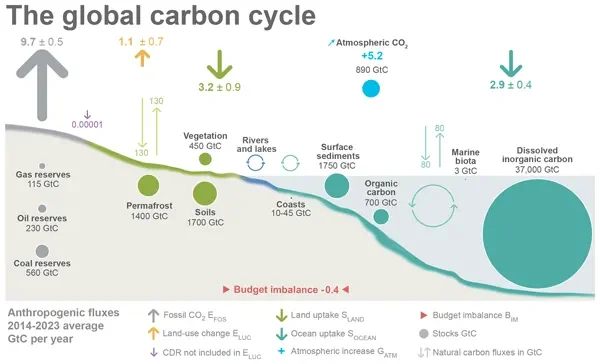
Friedlingstein et. al. (2024). Earth System Science Data, 17(3), 965–1039. https://doi.org/10.5194/essd-17-965-2025
So what did the pandemic teach us about sustainability? And how has it reshaped the ecological, social and economic systems that underpin our future?
A Stress Test for Sustainability
COVID-19 operated as far more than a health crisis: it constituted a planetary systems test. Supply chains fractured, energy demand plummeted, and human behaviour changed overnight. For sustainability professionals, the pandemic laid bare two fundamental truths:
Our global systems are deeply interconnected.
They are also deeply fragile.
When one part of the system falters - whether healthcare, logistics or energy - ripple effects propagate everywhere. Yet the crisis simultaneously demonstrated how swiftly humans can adapt when necessity demands it.

Photo by thomas Delmas on Unsplash
The Green Shifts that Took Root
Despite the upheaval, COVID-19 accelerated several key sustainability trends:
Remote Work & Digitisation: The mass shift to remote work reduced commuting emissions and compelled organisations to digitise operations at unprecedented speed. Even in 2026, hybrid work remains dominant: 24% of job postings offer hybrid arrangements and 11% are fully remote, with 29% of U.S. workdays still performed from home. This shift has permanently reduced business travel and office carbon footprints.
Localisation & Supply Chain Resilience: Companies confronted the cost of fragile global supply chains. Many began sourcing closer to home, diversifying suppliers and investing in circular economies; a shift that continues to reshape manufacturing and distribution networks.
ESG & Corporate Purpose: The crisis spotlighted the “S” in ESG—social sustainability. Employee well-being, community engagement and equitable access became central to corporate responsibility, with 88% of employers now providing hybrid work options as a core benefit.
Renewed Focus on Health & Nature: From air quality to green spaces, people became acutely aware of the link between environmental health and human health. This awareness has fuelled public demand for cleaner, more resilient cities and sustained advocacy on governments to prioritise climate action.
The strategic imperative towards renewable energy and circularity (more resilient, robust supply chains) has intensified considerably due to geopolitical shocks since COVID: the war in Ukraine calling reliance on Russian gas into question, and now in Iran, with the largest energy crisis since the 1970s, further accelerating the imperative to transition away from oil.
Where Progress Stalled
However, the pandemic also stymied sustainability in critical ways:
Economic Pressures Overrode Climate Goals: As governments scrambled to rebuild economies, many delayed or diluted green investments. Global CO₂ emissions grew 9% in 2024, with fossil fuel subsidies surging again as nations sought energy stability. The remaining carbon budget for limiting warming to 1.5°C now stands at just 235 GtCO₂; equivalent to roughly 6 years at current emission levels.
Waste Management Setbacks: A surge in single-use plastics—from masks to packaging—strained recycling systems worldwide. An estimated 8.4 million tonsof pandemic-associated plastic pollution entered the environment in the first year alone, with approximately 1.56 billion face masks ending up in oceans in 2020 alone. Daily production of face masks in China soared to 116 million in February 2020, twelve times higher than the previous month, and the global plastic waste footprint doubled to approximately 630 million tons in 2020, reversing years of progress in reducing plastic pollution.
Digital Overconsumption & Social Isolation: Lockdowns drove billions further into digital ecosystems, accelerating a shift towards screen-mediated life that outlasted the pandemic itself. Social media usage surged; influencer-driven consumption culture expanded its reach, fuelling impulse purchasing and fast-fashion cycles as well as further entrenching conspiracy theorist echo chambers, such as in the ‘manosphere’ and ultra-right ‘MAGA’ cells. Simultaneously, the erosion of in-person connection deepened loneliness epidemics across age groups, undermining the social fabric on which collective sustainability action depends.
Deepening Inequality: Low-income communities bore the brunt of both the pandemic and environmental degradation, widening the gap both between sustainability leaders and those falling behind - including within social strata of the very nations who call themselves leaders. The rebound in emissions and consumption demonstrated that systemic transformation cannot rest on temporary behavioural shifts; it requires structural reform and connecting with the lived reality of the left behind.

Photo by Ronny Navarro on Unsplash
Lessons Learned
Resilience proved far more than rhetoric during the pandemic. Resilient systems - local food networks, decentralised energy grids, adaptive supply chains - performed markedly better during the crisis. They adapted faster, absorbed shocks and recovered with less damage. For organisations, this translates to embedding adaptive capacity: the ability to pivot supply chains, maintain operations remotely and support employees through uncertainty. Nature offers the blueprint; diverse ecosystems withstand stress precisely because they can adjust. The same principle applies to human systems.
Rebuilding for Regeneration
Six years after the pandemic began, the data tells a sobering story. We are on track to exhaust the remaining carbon budget keeping us within the critical 1.5°C threshold within the next 6 years unless we achieve unprecedented emission reductions. Meanwhile, plastic waste continues to accumulate and hybrid work—one of the pandemic’s most significant sustainability shifts—faces resistance from corporate return-to-office mandates.
COVID-19 served as a painful reminder of how connected and vulnerable our global systems are. It both advanced and delayed sustainability progress; yet its greatest offering was perspective. We witnessed what becomes possible when the world acts collectively: emissions can drop, systems can adapt, and behaviour can shift with remarkable speed when necessity compels it.
The challenge now lies in harnessing that urgency for climate, equity and resilience before further global shocks force our hand; these have arguably come thick and fast, compounding in layers across each other into what some have called the ‘poly-crisis’. This is exactly why sustainability transformation is not a post-pandemic afterthought; it is the blueprint for surviving and thriving in the decades ahead. An essential strategic and health imperative, not merely a nice-to-have add-on, as ignorantly dismissed by some we encounter at tech networking events as less relevant and not ‘what businesses want these days’.. This is not what we hear on the ground and the reason why we wanted to retrace steps since the lockdowns of 2020-21 to comprehensively myth-bust this mis-information.